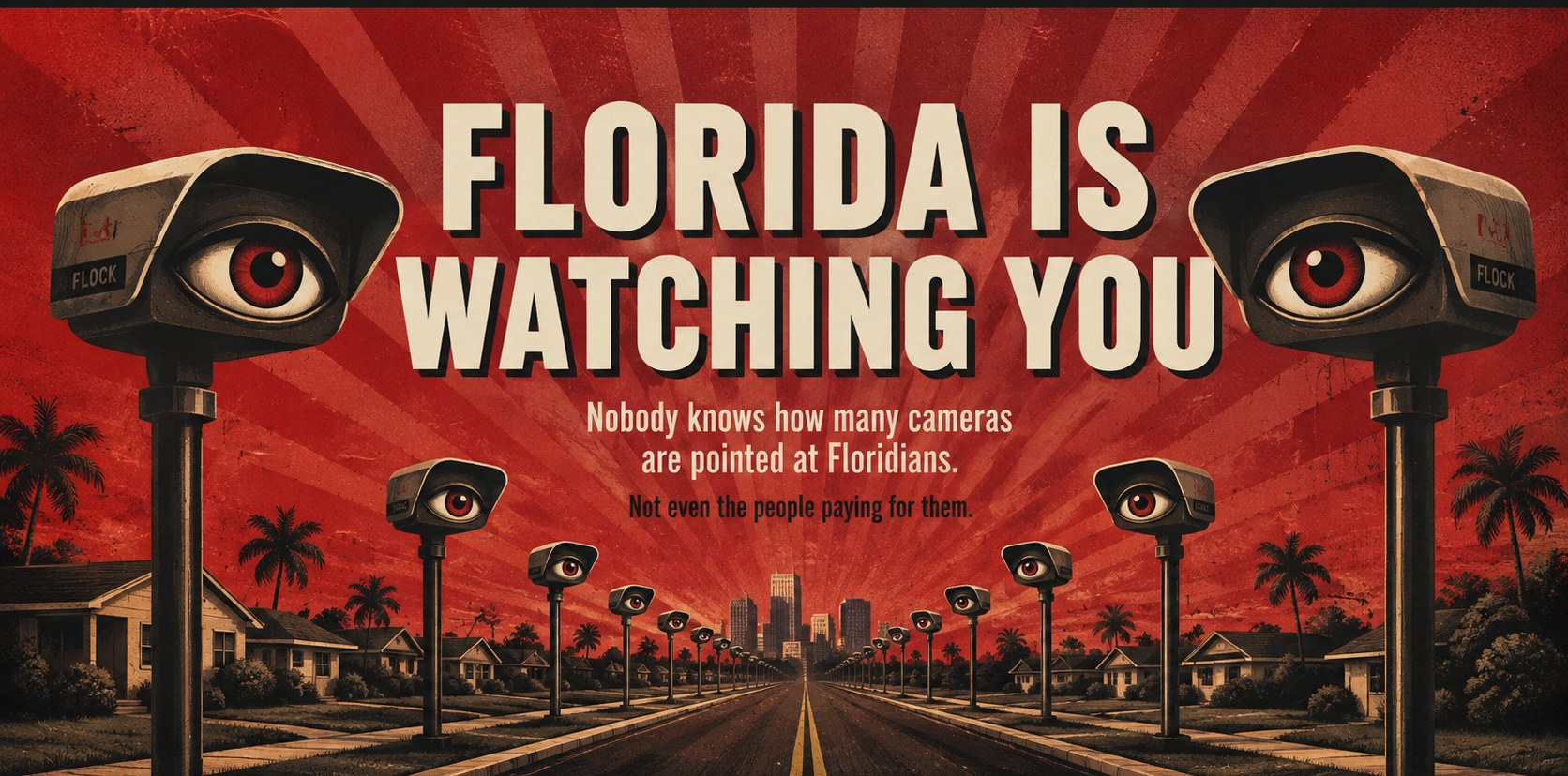
What they are doing to you
They are tracking where you go.
No warrant. No vote.
Automated plate readers photograph every car that passes. Not suspects, everyone. Where you sleep, worship, see a doctor, take your children, or attend a meeting is logged, kept, and shared with agencies you have never heard of, in states you have never visited.
"Unlike the nosy neighbor who keeps an eye on comings and goings, they are ever alert, and their memory is nearly infallible."
Chief Justice John Roberts · Carpenter v. United States, 2018 · Read the opinionIn Carpenter the Supreme Court ruled that police need a warrant before obtaining a person's location history, because it offers the government "near-perfect surveillance." The Court was describing 127 days of one man's phone records. Florida agencies are doing it permanently, to everyone, and calling it routine.
Florida's own constitution is even clearer than the Fourth Amendment.
Article I, Section 23 gives every Floridian the express right "to be let alone and free from governmental intrusion into the person's private life." Article I, Section 24 makes every government record yours by right. Both are being ignored, not by secrecy, but because almost nobody asks.
August 19, 2026
The plate reader was
only the beginning
Flock Safety, the vendor holding the Sumter County contract, has been building an AI system on top of the camera network. WIRED reconstructed it from more than 450 files that Flock's own login pages served to anyone who loaded them, and published the findings yesterday.
"I don't know how else to say this, but this sounds completely insane. I don't know how anyone can argue against the idea that Flock literally tracks people."
Noel Pichardo, former Pawtucket, Rhode Island police officer, who reviewed the prompts for WIREDThe tool was called Nightshift and is now called OS Investigate. It ships with 69 prewritten prompts an officer can select from a menu, and 45 tools reaching plate scans, arrest records, case files, 911 dispatch logs, ballistics results, and commercial databases holding Social Security numbers, dates of birth, phone numbers, email addresses, relatives and associates.
Nineteen of those prompts hunt for patterns instead of looking up a record. Fourteen need no plate, no name, and no description at all. The officer supplies a place, a window of time, and a behavior, and the system returns the people who fit.
Give the system one plate and it returns that driver's “top three associates.” The code counts how often other plates appear at the same cameras within a two-minute window, flags any that recur three or more times, and can return up to twenty vehicles. Nobody has to be suspected of anything for their car to end up on that list.
One prompt asks for records matching “male, ~6ft, black hoodie, forearm tattoo” near a location. The searches sort people by sex, race, ethnicity, height, weight, build, scars, marks, and tattoos, inside a radius or a shape the officer draws on a map.
Prompts ask for vehicles that visited three or more retail locations in three days, multiple banks in a week, or multiple gas stations between midnight and 5am. None of them names a suspect or an incident. A filter strips out buses, semis and work vans, so a delivery driver making those rounds drops off the list and an ordinary person making the same rounds stays on it.
By default an officer types a reason before searching. WIRED found the form places no requirement on what that reason says. Where a department also requires a case number, the form checks only that it contains at least three characters.
Source: WIRED, Dhruv Mehrotra and Dell Cameron, August 19 2026. Flock did not dispute the capabilities described, and says the product is in testing with a small group of agencies and may change before a broader release.
This is what the Sumter County contract connects to.
The agreement obtained from the Sheriff's Office has national sharing enabled. The network those cameras feed logs the movements of drivers in more than six thousand communities and records around twenty billion plate scans a month. Whatever gets built on top of that pool is built on top of every Florida plate in it, including yours, without anyone in this state voting on it.
Flock's own public trust pages tell customers the technology is built for specific, case-based investigations and “not for watching people.” The ACLU's Jay Stanley told WIRED that what he saw in the code is hard to square with that, and that there is now, “in some ways, like China, very little space between what can be done and what is being done.”
Facial recognition
They are scanning your face
The one Florida county examined so far turned out to hold a contract covering facial recognition software. No agency disclosed it, explained it, or put it to a vote. Unlike a plate reader, facial recognition does not require you to be in a car, and a false match does not misidentify a vehicle. It misidentifies you.
Detroit · January 2020
Robert Williams was arrested in front of his children because a computer matched his face to a blurry photograph.
He was held about eighteen hours. In his words: "I spent the night sleeping on the cold concrete floor of a filthy, overcrowded cell next to an overflowing trash can." He had done nothing. He was the first American known to be wrongly arrested by facial recognition. He was not the last.
Already happening
Six times it was turned on the wrong people
Every entry below is documented and sourced. None of it is from China. One of them happened here, and one of them could reach here from a thousand miles away.
Sumter County detective Brandy Almany was arrested and fired after investigators found she had used the Flock plate reader database, the state driver database, and the court records system to follow a private woman. She was charged with official misconduct. According to the sheriff's office she created official-looking records to disguise the searches as legitimate police work. Sheriff Pat Breeden suspended the plate readers and ordered an audit of who has access to what.
The Associated Press obtained hundreds of pages of secret NYPD documents. Its reporters wrote that the department's Intelligence Division “snapped pictures and collected license plate numbers of congregants as they arrived to pray,” and that police “mounted cameras on light poles and aimed them at mosques.” Attending a house of worship was the whole basis for being recorded.
Brittney Gilliam took four girls out for a nail appointment. Police surrounded the car with guns drawn and put the children face down on the asphalt in handcuffs, the youngest six years old. The department's system had flagged her Colorado plate as stolen. The vehicle actually stolen was a motorcycle in Montana carrying the same plate number. Aurora settled for $1.9 million in February 2024.
Search logs first obtained by 404 Media show a Texas officer ran a query across more than 83,000 cameras nationwide while looking for a woman who had self-administered an abortion. Florida bans most abortions after six weeks. Every camera in this state that shares nationally is reachable by exactly that kind of search, run from a state whose laws Floridians did not vote for.
A Washington Post analysis found fifty officers charged with or accused of misusing plate reader systems. Twenty-six of them were tracking wives, girlfriends, exes, or women they wanted to meet. The Electronic Frontier Foundation reviewed more than twelve million logged searches and found roughly one in five gave a reason no more specific than “investigation” or “query,” while more than fifty agencies ran hundreds of searches whose stated reason referenced protest activity.
The Institute for Justice now maintains a running tracker of plate reader misuse across the country. It counts over 140 cases: officers stalking romantic interests, wrongful stops, wrongful detentions, and searches run for reasons that had nothing to do with law enforcement. Senior attorney Robert Frommer said that supervisor approval and audit logs “fall short in the real world” and would “at most possibly catch some bad actors after the fact, when the damage has already been done.”
The equipment worked correctly every time.
A woman followed by her ex-husband's new wife, a congregation arriving for prayer, four children on the ground in a parking lot, and a woman hunted across eighty-three thousand cameras for a medical decision. None of these were malfunctions. The equipment did what it was built to do, and the only variable was who decided to point it at whom. The Sumter detective is the part worth sitting with, because she covered her tracks inside the audit trail itself. That is the safeguard Florida agencies point to when residents ask who is watching the watchers.
Where this ends
In Xinjiang, China placed cameras roughly every hundred meters and facial recognition checkpoints across whole cities, then used them against Uyghurs, Christians, and Falun Gong practitioners, identifying people by face, logging their movements, and scoring who could be trusted.
That system was not installed all at once. It grew from traffic cameras, to crime cameras, to a database, to a shared network, and each addition was defended on its own terms. The difference here is that none of it is hidden. Florida law makes every contract, invoice, and camera location available to anyone who asks for it. For years, in sixty-six of sixty-seven counties, nobody did. 67 / 67 counties have now been asked, and what they send back is published here.
What else they already have
The cameras are one feed of many
A record that your car passed a camera on Tuesday means little by itself. It becomes powerful when joined to the other records that already exist about you, most of which government agencies do not need a warrant to obtain, because they simply buy them.
Eighteen thousand cameras, from the two cities that bothered to publish a number.
Axon runs a program called Community Connect that lets residents and businesses hook private security cameras up to their local police department. Orlando's page reports 7,240 cameras registered and 4,092 fed directly to police. Miami reports 2,406 registered and 4,399 integrated. That is 18,137 cameras across two cities, published by the vendor on its own website, before any resident filed a single records request.
21 of the 23 Florida programs publish no count whatsoever. There is no reason to assume those are small. There is only nobody asking.
Two honest caveats, because this site does not survive being wrong. These are private security cameras, not license plate readers, and the program is voluntary. Nobody is forced to connect a camera. People sign up because they want their street watched, which is precisely how a network this size gets built with no vote, no budget hearing, and no public notice.
Purchased location data
Source: ODNI declassified report (PDF)
Local police buy it too
Source: EFF investigation
Your face, already scraped
Source: Dutch Data Protection Authority
Bought, not warranted
Source: ODNI declassified report (PDF)
Those twenty-three programs run across fifteen Florida counties. A camera you bought, mounted on your own house, becomes a camera a police console can pull up. Read the full report →
The Governor now says it out loud.
On 26 August 2026, at Florida International University in Miami, Governor Ron DeSantis said of automated license plate readers: “I think it’s out of control.” He called for the system to be “overhauled for sure,” and warned against Florida becoming a “surveillance state.”
He was reacting in part to a Florida officer who used Flock to track his estranged wife: “What the hell’s going on with this? … I think people are right to be concerned.”
He also said where the problem sits: not with state agencies, but with “Police Departments and Sheriff’s Departments, by and large.” Those are precisely the agencies this project has been writing to, and the ones least willing to answer.
Source: Florida Politics, A.G. Gancarski, 26 August 2026; also News4JAX, WFLA, WPEC, Newsweek. Florida has roughly 7,500 license plate readers (WUFT); at least 100 Florida agencies use Flock (GovTech).
The price of asking
Asking What They Operate
Costs Up To $7,571.18
We sent one identical records request to every agency in this state. Same wording, same technologies, same dates. Florida law lets an agency charge for its time when a request is genuinely burdensome. This is what came back.
The fee leaderboard
Highest amounts stated in the response records, ranked once per agency and county. These may be estimates, deposits, or quoted fees—not a ruling that any charge was lawful or unlawful.
The same work, priced from $20.00 to $250.00 an hour.
Daytona Beach Shores quoted 100 hours of staff time. Independent research records that department as operating six plate readers.
Highland Beach quoted $2,025.96 and itemized all of it: thirty-five hours at $55.00, twenty of them for six years of vendor email. Large, but explained, and the email is the item a requester can drop.
The Madison County Sheriff’s Office, which has no records division at all, was asked what made the request extensive and answered every part of it: the items, the classification, the rate, the hours, and the arithmetic. It charged $48.00 and refunds whatever it does not use.
Almost nobody charged. The reviewed response set contains 50 stated fee amounts. Each one is preserved as an estimate, deposit, or quoted fee until the underlying response establishes what was actually paid.
A fee that is not explained cannot be checked. Section 119.07(4)(d) allows a charge only where the work is genuinely extensive, and requires it to be reasonable and based on the cost actually incurred. Several agencies close the request if you do not pay within ten or thirty days, so querying the bill can cost you the records.
Countries that finished building it
Where this goes if nobody stops it
Each country below built its system out of tools that were defended individually and reasonably. None of them ever held a vote on the finished result.
Researchers reverse engineered the police mass surveillance app used in Xinjiang and documented how it aggregates personal data to flag ordinary, lawful behavior as suspicious, feeding a system used against Uyghurs and other minorities. Cameras and facial recognition checkpoints were installed throughout entire cities.
Blacklisting has been used to deny travel at scale, blocking tens of millions of air and rail ticket purchases, along with restrictions on hotels, property, and schooling.
Russian law permits state agencies to monitor communications without a warrant, and the country operates a national vehicle tracking system that follows cars by reading their movements, which is the same category of tool now on Florida roads.
The European Court of Human Rights ruled that this surveillance framework violated human rights protections.
The Investigatory Powers Act requires communications providers to retain records of every customer's connections, and authorizes bulk collection and equipment interference. Britain is the instructive comparison precisely because it is a functioning democracy that simply never stopped expanding what it collected.
This is the one to read carefully, because Canada is not an authoritarian state and this happened four years ago.
During the trucker convoy protests the federal government issued the Emergency Economic Measures Order. It required banks, credit unions, and investment firms to freeze the accounts of any “designated person,” which the Order defined as anyone engaged directly or indirectly in a prohibited assembly. No charge was required. No conviction was required. No judge made any finding. The same Order required those institutions to report their customers to the RCMP and the intelligence service without delay, and shielded them from being sued for doing it.
The public inquiry that followed found that roughly 280 accounts holding about CAD$8 million were frozen, and that the Order “did not set out a process for unfreezing accounts.” The Commissioner also found that a person with no connection whatsoever to the protests could have their money frozen simply by sharing a joint account with someone who attended, calling that outcome “clearly unjust.”
Nobody voted on it. The infrastructure that made it possible, a financial system that knows every account holder and can be directed centrally, was built for ordinary reasons over decades.
Source: Emergency Economic Measures Order, SOR/2022-22 and the Public Order Emergency Commission final report
The pattern
In every case the capability was built first and the rules were argued about afterward.
No legislature voted to create a surveillance state. Each was assembled from individually defensible tools, and proved very hard to dismantle once complete. Florida is early in that sequence, which is the only advantage residents currently have.
Do something today
Demand they answer for it
These offices approve, fund, permit, or oversee every camera in this state. Most have never received a single message about it, which is exactly why the networks keep growing. Ask them to take the cameras down.
State
The governor
Banned a digital currency over the same surveillance argument. Plate readers already do it.
Federal
Senators & Congress
Plate data already flows to federal agencies through national sharing networks.
Local
Your sheriff & commission
They sign the contracts and vote the budget. They are the ones who actually decide.
Look up your home
Is anyone watching where you live?
Type your county. Dark grey means no vendor data has surfaced yet. Amber means a vendor is documented as operating there. Red means the agency has produced records. A count on an amber tile is the number of plate readers the EFF Atlas of Surveillance reports across that county's agencies, not a figure we obtained. A count on a red tile came from the agency's own records production. The county page names each agency and marks every line as either third-party research or something the agency told us directly. Requests are now filed in 67 / 67 counties, and the county page shows what was asked and when.
67 counties shown
Published reports
Read the full record
Long-form reporting drawn from the records obtained so far.
Help fill the map
Send us what you get back
Anyone can file a records request in Florida. No fee, no form, no reason required. When an agency answers you, forward it here and we will publish the documents with their hashes.
- Ask your sheriff and your county for contracts, invoices, camera locations, data-sharing agreements, retention policy, audit logs, and any facial recognition software.
- Name the vendors: Flock Safety, Motorola/Vigilant, Axon, Genetec, Rekor, NDI Technologies.
- Do not accept "no records." Ask what they searched. The law requires a specific exemption for anything withheld.
- Forward the response with the original attachments and tell us the county and agency.
We publish documents, never requesters. Say the word and your name never appears.